
Ajax’s Ambitious Rebuild: Can a New Transfer Strategy Take the Dutch Giants Back to the Top?

Following Ajax's joint-worst finish in 26 years, the club appeared to be entering a downward spiral. Yet this summer, it has managed to sign some of the biggest names it has landed during that period in an attempt to return to the top of Dutch football and European competition.
Who are AFC AJAX?
Founded in Amsterdam on 18 March 1900, AFC Ajax is one of the most successful and historically significant clubs in European football. The club has won a record 36 Dutch league titles, more than any other side in the Netherlands, as well as four European Cups/Champions League titles.
Ajax's reputation extends beyond its success on the pitch. The club is renowned for its youth academy, which has produced generations of first-team players and some of football's most recognisable names, including Johan Cruyff and Marco van Basten.
However, Ajax's success has been far from recent, with the club having gone trophyless over the past five seasons.
Season 2025/26
Ajax started the 2025/26 season with a new manager, John Heitinga, whose appointment came as a shock to the club and its fans following Francesco Farioli's successful season. Following a summer in which €50 million was spent, the Amsterdam-based club was looking to build on its second-place finish after narrowly missing out on the title on the final matchday, as well as return to the Champions League after a three-year absence.
Ajax went eight games unbeaten in the league to start the season. In most scenarios, this would have been seen as an encouraging sign, but only four of those eight games resulted in three points.
Just 88 days after Ajax's opening game, John Heitinga was sacked, with the club sitting fourth with a record of five wins, five draws and just one loss. Nevertheless, Ajax was already eight points behind league leaders Feyenoord just 11 games into the season.
The league form alone did not explain Heitinga's dismissal, as the Champions League campaign also had to be considered. During Heitinga's spell, four games were played: no wins, just one goal scored and a whopping 14 conceded, leaving the club dead last in the standings with a −13 goal difference. This was the worst record in the Champions League since the introduction of the new league-phase format and one of the worst in the competition's long history since 1955.
By the end of the season, the club had finished in fifth place following a winless final three games, securing only two out of a possible nine points. This meant Ajax missed out on third place and, with it, Champions League qualification.
After beating FC Groningen and eventually FC Utrecht in a penalty shootout, the Amsterdam side managed to secure a place in the second round of the UEFA Conference League, a small bright spot in what was otherwise a disastrous season.
Enterprise Value
In 2025, AFC Ajax was valued at €536 million, making it the most valuable club in the Netherlands, ahead of the likes of PSV and Feyenoord. It was not all positive, though, for the Amsterdam-based club, as this represented a 22% decline from the previous year, 2024, when it was valued at an all-time high of €687 million. Over the period from 2017 to 2024, the club's value increased every single year, starting at €330 million.
When looking at enterprise values, it is important to note that these valuations do not directly correspond to the football season of the same year, as each figure reflects the club's financial and sporting performance from the preceding period. For example, the 2020 value would correspond to its 2018/19 season in terms of both performance and finances.
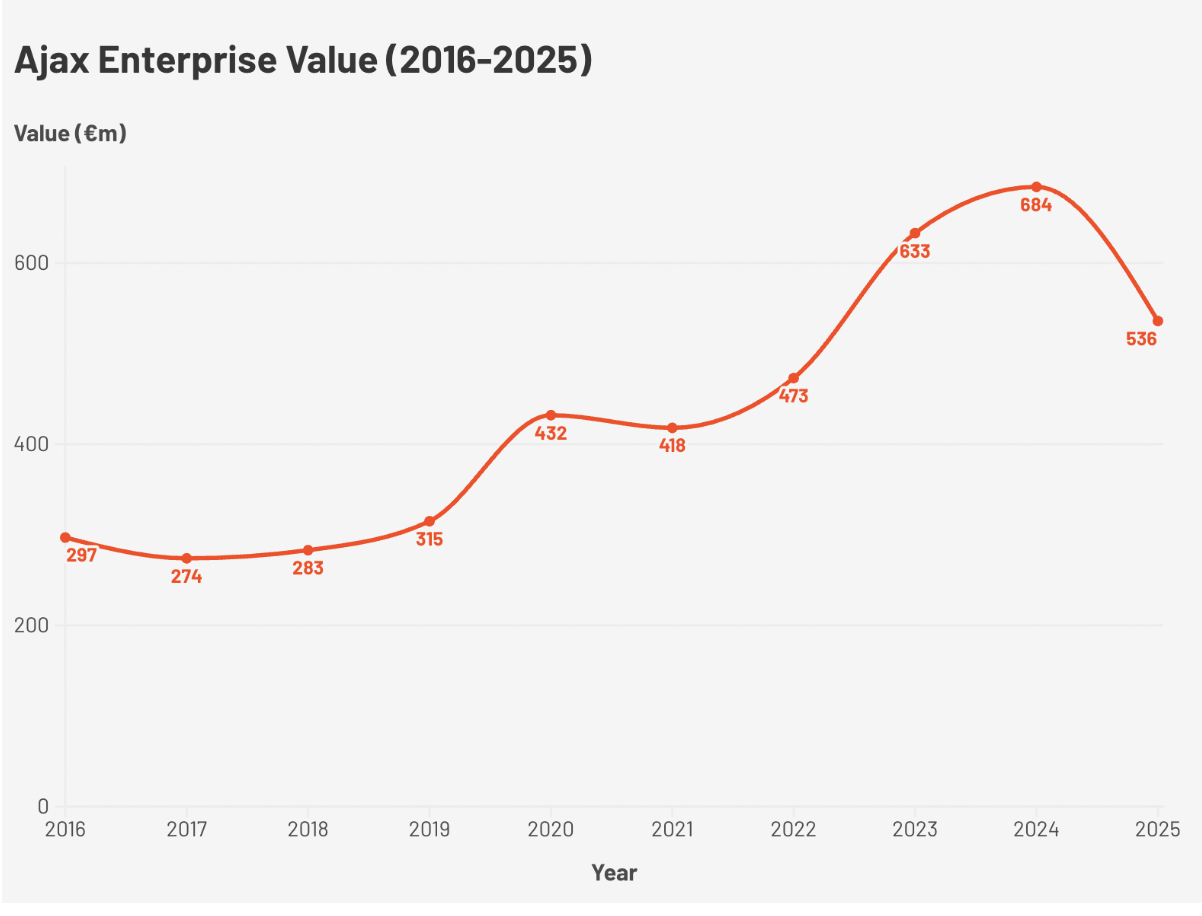
Figure 1: Ajax Enterprise Value from 2016 to 2025
In 2020, the club experienced its biggest annual change, with a positive shift of 37.1%. The increase can be heavily linked to its success in the 2018/19 Champions League campaign, when Ajax reached the semi-finals and came within inches of the final before Lucas Moura scored in the dying seconds to send Tottenham Hotspur through on away goals.
The UEFA website notes that AFC Ajax received €78.549 million. Had the club reached the final, it could have received a further minimum of €15 million or a maximum of €19 million, depending on the result.
After reaching the Champions League semi-finals for the first time in 22 years, it was always going to be a major challenge to reach those same heights again the following season. This proved too difficult for the club, as Ajax was knocked out of the competition in the group stage. Its sporting performance was significantly worse than the previous season, yet the club's enterprise value only decreased by €14 million, a relatively minor 3.2% decrease.
The only other time the club saw its enterprise value decrease was in the most recent season for which figures are available. In 2025, Ajax's enterprise value was set at €536 million, a 21.6% decrease from 2024.
This followed a fifth-place finish in the 2023/24 Eredivisie season, its lowest in 24 years, while the club also failed to qualify for the knockout stage of the Europa League, let alone the Champions League. Following its group-stage exit from the 2023/24 Europa League, the club did manage to reach the Round of 32 of the Conference League. This did not last long, as Ajax were defeated by Aston Villa, resulting in a mere €300,000 prize money from the Conference League. In total, the club earned €10.6 million from that European season, its smallest amount since 2016.
Transfers
When you mention or think of Ajax, one of the first things that comes to mind is its world-renowned youth academy. Over the years, Ajax has produced countless players who have risen through the youth academy, integrated into the first team and become regular starters.
This philosophy was outlined by then-technical director Alex Kroes in an interview in the summer of 2024:
"For the long-term future of Ajax, it is a must to sell players. But it requires careful balancing. It is up to us to find an undervalued player in terms of transfer value and give them the opportunity and space to develop. But that also applies to our youth players." - Alex Kroes, Ajax's former technical director
This philosophy has helped Ajax rank second among football clubs worldwide for transfer income generated from club-trained players over the past 10 years.
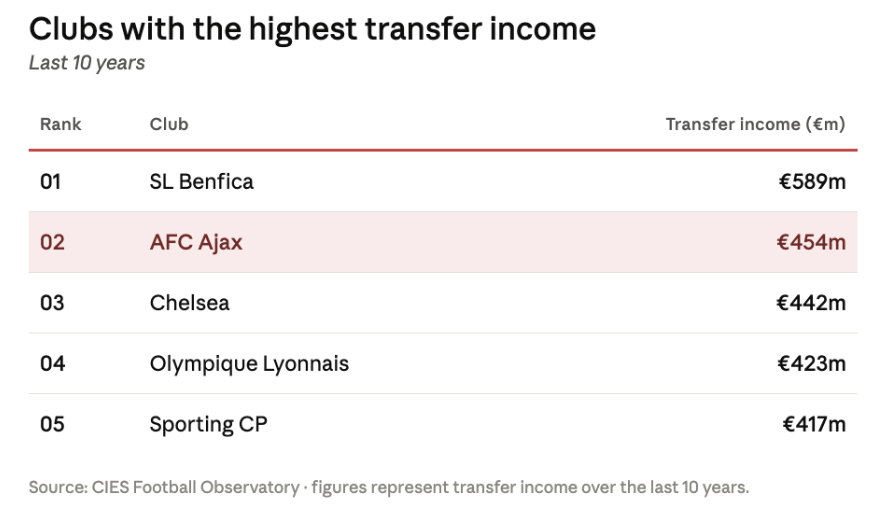
The ability to develop players within the academy and sell them for significant fees has become an important part of Ajax's financial model, allowing the club to generate substantial revenue from player sales.
Since 2016, four of the ten biggest transfer sales have been academy graduates, generating total transfer revenue of over €200 million and demonstrating Ajax's ability to turn developed players into significant income. The club is not only reliant on the academy for its sporting success on the pitch; it is also critical to its financial performance, allowing Ajax to sell homegrown players for significant profits.
Ajax's recruitment strategy does not stop at its academy. Alongside developing homegrown talent, the club has built a reputation for identifying players whose potential is greater than their current market value. The other six of the club's ten largest outgoing transfer fees came from players purchased at substantially lower values than they were later sold for. These six names include:
Antony: €15.75m → €95.90m
Frenkie De Jong: €300k → €86.00m
Lisandro Martinez: €7.00m → €57.37m
Mohammed Kudus: €9.00m → €43.00m
Davinson Sanchez: €5.50m → €42.00m
Hakim Ziyech: €11.00m → €40.00m
Collectively, Ajax paid €48.55 million for these six players and later sold them for a combined €364.27 million, a difference of €315.72 million between purchase and sale fees. The figures highlight the scale of Ajax's ability to identify and develop talent before its market value reaches its peak.
Across the last 10 seasons, from 2016/17 to August 2026, Ajax has spent a total of €590.45 million on incoming transfers while generating €1.18 billion from player sales, resulting in net transfer income of €591.74 million.
However, this success has not followed a linear path. At certain points, Ajax has departed from its traditional approach of identifying undervalued players and developing them into valuable assets, most notably during Sven Mislintat's time as director of football.
Sven Mislintat arrived at Ajax with an extensive and diverse background across multiple areas of the sport. The German had spent 11 years at Borussia Dortmund, first as head of scouting and later as head of professional football, before becoming Arsenal's head of recruitment in 2017. In 2019, he returned to Germany as sporting director of VfB Stuttgart, where he remained until 2022. Ajax appointed him director of football in May 2023, following the departure of Marc Overmars the previous year.
His time in Amsterdam, however, was remarkably short-lived. Mislintat oversaw a major overhaul of the squad during the summer of 2023, bringing in 13 new players for €109.3 million in transfer fees.
As of the start of the 2026/27 season, just Anton Gaaei remains in an active at the club, with the remaining 12 players having either been sold or sent out on loan. Notably, none of the players sold has generated a fee greater than their original purchase price.
Not only did the club's finances take a substantial hit, but so did its performance on the pitch. As outlined earlier, Ajax finished fifth in the 2023/24 season and failed to reach the knockout stage of the Europa League.
Therefore, just four months into his stint as sporting director at Ajax, Mislintat was shown the exit as the club encountered its worst-ever start to a league campaign. After 10 matchdays, although Ajax had played only eight matches at the time, the club sat rock bottom for the first time in its history, 25 points behind the league leaders. This subsequently contributed to Ajax's enterprise value suffering its largest decrease.
The scale of the spending represented a significant departure from the transfer model outlined earlier in this article. Rather than focusing primarily on relatively inexpensive players who could be developed and later sold for a large profit, Ajax committed substantial fees to a large number of new signings in a single window.
Season 2026/27
Entering the 2026/27 season, Ajax is looking to bounce back after a poor campaign. The season started early, with the first competitive match taking place on 23 July, just two months after the 2025/26 season officially ended.
The summer transfer window has given new technical director Jordi Cruyff, son of football legend Johan Cruyff, his first chance to reshape the squad.
There have certainly been changes, with the club having already made six major signings: Caio Henrique from AS Monaco, Daley Blind from Girona, Marcos Leonardo from Al-Hilal, Tolu Arokodare from Wolverhampton Wanderers, Julian Brandt from Borussia Dortmund and, most recently, Marc-André ter Stegen from FC Barcelona.
All six are big names from elite-level clubs around the world, with only Marcos Leonardo and Caio Henrique purchased for transfer fees, costing €19.90 million and €10.50 million respectively. The other signings all joined on free transfers or on loan.
Only Sean Steur and Chuba Akpom were sold, for a combined €22.80 million, before the acquisition of these players. Therefore, the question still remains:
How is Ajax able to afford these players?
Take, for example, 48-time German international midfielder Julian Brandt, who earned roughly €9 million a year at Borussia Dortmund. This is a figure Ajax simply cannot match, given the club's salary cap of €5 million per player.
With Brandt 30 years old and still putting up good numbers for Dortmund, contributing to 11 goals in 29 Bundesliga games last season, how has a player still playing Champions League football taken such a significant pay cut to join Ajax?
Ajax managed to convince Brandt to join through a smart loyalty bonus in his contract. Brandt will receive a bonus based on the length of his contract, which will increase at the end of every football season, giving him an incentive to stay at the club.
Furthermore, it was reported by Algemeen Dagblad that there was a significant signing bonus and several performance-related milestones that aided Ajax's attempt to bring Brandt in. The exact figures remain unknown.
The club has also employed a loan strategy, bringing in players on loan while their parent clubs help cover their salaries. Ajax has made two loan signings: Tolu Arokodare and Marc-André ter Stegen, the latter being the more notable of the two, given that Ter Stegen is a Champions League winner and seven-time La Liga champion.
Ter Stegen is reported to be earning around €14.5 million gross per year at Barcelona, nearly three times Ajax's salary limit for a player. Therefore, finalising a deal for Ter Stegen was far from easy.
The Athletic broke the news on 3 July that Ajax and Barcelona had reached a verbal agreement for the loan. However, during the weeks that followed, the deal stalled due to disagreements between Ter Stegen's representatives and Barcelona regarding how his wages would be handled while he played in Amsterdam.
Eventually, on 31 July, Ter Stegen was announced as a new Ajax player, with Ajax set to pay only 10% of the German goalkeeper's wages.
This summer's window has been far from Ajax's usual strategy, with the club pursuing a more aggressive approach and departing from its focus on young, undervalued players. The new signings have an average age of 29.5.
This was perhaps to be expected when Jordi Cruyff was appointed, with the Dutch technical director stating that he aimed to bring Ajax back to glory following its fifth-place finish. Cruyff also targeted an immediate challenge for the Eredivisie title, a competition Ajax has won a record 36 times, more than any other club.
However, despite its historic dominance, Ajax has now gone five seasons without lifting the league title.
Ajax is participating in the UEFA Conference League qualification rounds following its win in the Eredivisie play-offs to qualify for this stage of the tournament.
Ajax faced Vojvodina of Serbia and Shelbourne of Ireland in the second and third qualifying rounds of the Conference League, beating them 8-2 and 5-3 on aggregate respectively. This has resulted in the club already accumulating €350,000.
In the play-off qualification round for the UEFA Conference League, Ajax faces Swiss side Sion in an attempt to qualify for the tournament's main group stage. If the club fails to defeat Sion across the two ties, it will receive a payment of €750,000. However, if Ajax manages to qualify for the UEFA Conference League group stage, it will automatically receive €3.17 million.
It is a tie that could mean a great deal for the club's financial position and its chances of strengthening the squad further before the transfer window shuts on 2 September.
What Comes Next?
After several disappointing seasons, declining enterprise value and a failed attempt to move away from its traditional recruitment model, the club appears to be taking a much more aggressive approach in an effort to return to the top.
The arrival of experienced players such as Julian Brandt and Marc-André ter Stegen shows that Ajax is prioritising immediate improvement, even if that means temporarily moving away from its usual focus on young and undervalued talent.
The challenge will be finding the right balance. Ajax still needs to protect the academy and recruitment model that has been central to its sporting and financial success, while also building a squad capable of competing for the Eredivisie title and returning to the latter stages of European competition.
A historic club that has endured several difficult years is now looking to return to the top and restore its place among Europe's elite. Whether this new strategy proves successful will depend on how quickly the new signings can make an impact and whether Ajax can turn its ambitious summer into results on the pitch.